
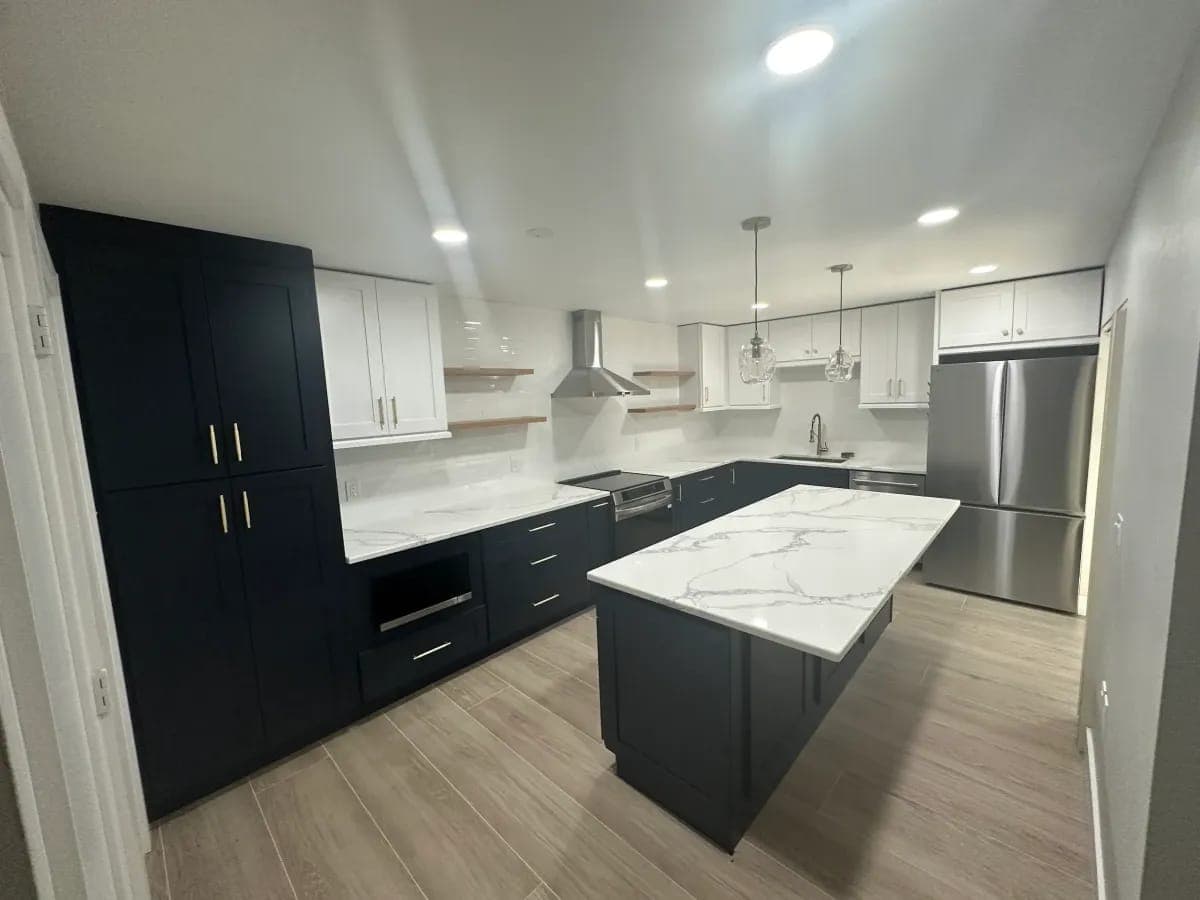
This is the question we field more than any other, usually phrased as “it's just a bathroom, do we really need a permit?” The answer is genuinely clear once you know where the line sits, and Palm Beach County draws it in a published document called “Items Not Requiring a Permit.”
The principle underneath the whole list is this: replacing something exactly as it is, in the same place, generally does not need a permit. Moving it, changing its configuration, or opening up a wall to get at it generally does.
What the county says you can do without a permit
These come straight from the county's own list, and the qualifiers matter as much as the items:
- Kitchen cabinets — “exact replacement only with no change in configuration of electrical or plumbing.”
- Sink — “exact replacement in same location only.”
- Water closet (toilet) — “replacement in same location.”
- Dishwasher — “exact replacement; same wattage.”
- Faucet — “replace existing (not involving removal of drywall).”
- Ceramic tile — “remove and replace,” provided it is not on a fire-rated assembly.
- Outlets and switches — replacing like for like within the existing junction box.
- Light fixtures — replacing “like for like” in an existing lighting outlet.
- Interior doors — removing and replacing in the same location.
Read those again and notice how much work the phrases “exact replacement,” “same location” and “no change in configuration” are doing. Almost every real remodel breaks at least one of them.
Which means a real remodel almost always needs a permit
If your project involves any of the following, plan on pulling one:
- Moving a sink, toilet, shower or any drain — relocating plumbing is the clearest trigger there is.
- Changing the cabinet layout in a way that moves outlets, switches or plumbing rough-in.
- Removing or altering a wall, whether or not you think it is load-bearing.
- Adding circuits, moving electrical panels, or adding recessed lighting where none existed.
- Converting a tub to a walk-in shower — this changes the drain and the waterproofing assembly.
- Replacing exterior windows or doors beyond the narrow exemptions on the county list.
Martin County works differently
If your home is in Stuart, Palm City, Hobe Sound or anywhere else in Martin County, you are not dealing with Palm Beach County at all. Martin County's building department states it plainly: a permit is required to remodel a residence.
That department is at 900 SE Ruhnke Street in Stuart and can be reached at (772) 288-5916. They publish checklists by project type, and in our experience the process is predictable when the submittal is complete on the first pass.
And your municipality may add another layer
Palm Beach County's rules govern unincorporated areas. If you live inside a municipality — West Palm Beach, Boca Raton, Jupiter, Wellington, Boynton Beach, Palm Beach Gardens and the rest — that city or village runs its own building department, and its requirements can be stricter than the county's.
The Town of Palm Beach is the clearest example. Homes in historic districts or with landmark status go through architectural review before a building permit is issued, and that review governs the schedule far more than the permit itself does.
Why permits are worth it even when they feel like friction
Homeowners occasionally ask whether they can skip the paperwork. Three reasons not to:
- Unpermitted work surfaces when you sell. Title and inspection turn it up, and buyers use open or missing permits as leverage — or walk.
- Insurance claims get complicated. If unpermitted work contributes to a loss, expect the carrier to ask about it.
- Inspections catch real problems. Shower pan waterproofing, drain slope, and electrical in wet locations are exactly the things a second set of eyes should verify.
Who pulls it
Your licensed contractor should pull the permit in their name. That matters more than it sounds. When a contractor asks the homeowner to pull an owner-builder permit for work the contractor is performing, the homeowner takes on the legal responsibility for that work — and loses much of the protection the licensing system exists to provide. It is a meaningful red flag.
At Palm Beach Renovations we pull permits under our license, schedule the inspections, and meet the inspector on site. It is part of the job, not an extra.