
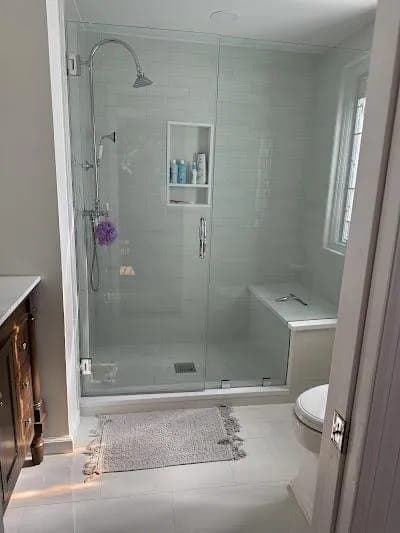
Every failed shower we have been called to repair looked fine on the day it was finished. That is the whole problem with waterproofing: it is invisible, it is the cheapest place for a contractor to cut, and the consequences show up two or three years later as a soft spot in the hallway floor or a stain on the ceiling below.
In South Florida the margin for error is narrower than most of the country. Ambient humidity is high year-round, bathrooms dry out slowly, and coastal homes add salt to the equation. A shower that would survive in a dry climate can fail here.
Tile is not waterproof
This surprises people. Tile and grout shed water, but they are not a barrier — grout is porous and water passes through it. Every tiled shower relies on a waterproofing layer behind or beneath the tile to actually contain the water and direct it to the drain.
When that layer is missing, wrong, or installed carelessly, the tile still looks perfect. Water just goes somewhere else — into the framing, the subfloor, or the wall cavity.
What a properly built shower has in it
- A sloped substrate that actually falls to the drain, with no flat spots that hold standing water.
- A continuous waterproof membrane — sheet or liquid-applied — across the pan and up the walls to the required height.
- Every inside corner, change of plane and pipe penetration sealed with the manufacturer's matching detail, not with whatever caulk was on the truck.
- A drain assembly compatible with the membrane system, correctly bonded to it.
- Cement backer board or a foam board system on the walls — never standard drywall inside a wet area.
- Cure and, where the system calls for it, a flood test before a single tile goes on.
Curbless showers raise the stakes
Curbless walk-in showers are the most requested bathroom feature we build, and rightly so — they look better, they are easier to clean and they let a bathroom work for decades as needs change. They are also less forgiving.
Without a curb, the only things stopping water leaving the shower are correct slope and a properly placed linear drain. That usually means recessing the subfloor or building up the surrounding floor, and the waterproofing has to extend well beyond the shower footprint. It is entirely achievable. It is not the place to hire on price.
Ventilation is part of waterproofing
A bathroom fan is not a comfort feature in Florida, it is moisture control. Two failures are common: a fan too small for the room, and a fan that vents into the attic rather than to the outside. The second is remarkably widespread and quietly ruins attic sheathing and insulation.
We size the fan to the room, duct it properly to the exterior, and where it makes sense put it on a humidity sensor or timer so it runs long enough after a shower to actually dry the space.
Questions worth asking any bathroom contractor
- Which waterproofing system are you using, by name?
- Do you flood test the pan before tiling, and can I see it?
- How is the shower niche waterproofed — that is the most common leak point in the room.
- Where does the exhaust fan terminate?
- Is the wall blocked for grab bars now, in case they are wanted later?
A contractor who answers those confidently is telling you a lot about how they build. One who waves them off is telling you something too.